Building Smart with BIM Laser Scanning
Leveraging 3D Laser Scans for Better Project Management
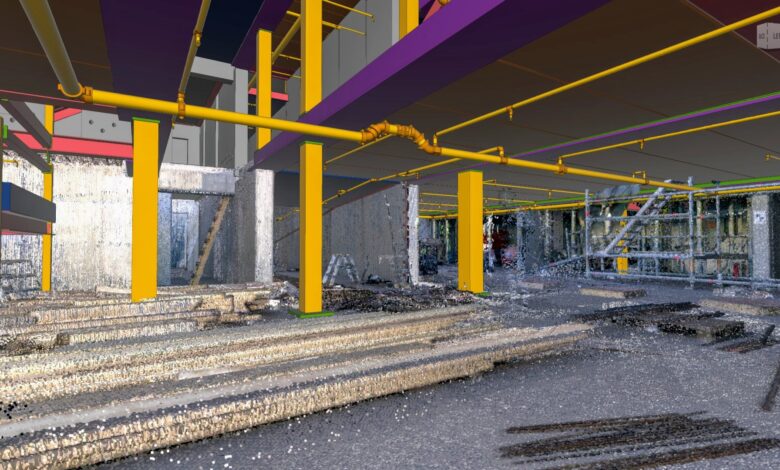
BIM laser scanning is familiar in architectural and construction landscapes and has been around for decades. However, laser scanning technologies are becoming increasingly accessible and affordable, allowing architects and construction engineers to quickly implement them into their workflows with devices as ubiquitous as next-generation iPhones equipped with LiDAR and SLAM. These technologies rapidly transform construction processes, project management, and design decisions.
Overview of BIM and 3D Laser Scans
BIM laser scanning is a 3D modeling process that helps architects and construction engineers gain insight into their projects before building them. In other words, after the initial conceptual design phase, BIM helps model the physical and functional characteristics of a building. Imagine a 3D representation of your establishment or site – everything from structural elements to complex components in CAD format. BIM helps create this model and ensures all stakeholders can access real-time data. Consequently, BIM lets architects and construction engineers make better decisions before the construction phase begins reducing the potential for rework or unexpected challenges.
In addition, virtual models can be helpful in various stages of a building’s life cycle, including design, construction planning, management, operations, and maintenance. Before the BIM process begins, architects and construction engineers must create a highly detailed 2D or 3D model of their building. The BIM process is often time-consuming and can be difficult to complete accurately. 3D laser scanning technologies like LiDAR and SLAM can make this process faster, easier, and more accurate.
LiDAR
Light Detection and Ranging (LiDAR) uses pulsed laser light to measure distances and create a detailed 3D model of a building or site. LiDAR is often used in outdoor applications, such as surveying, mapping, and architecture. It is highly accurate and can capture the exact dimensions of a building or site quickly and accurately.
SLAM
Simultaneous Localization and Mapping (SLAM), on the other hand, uses sensors such as cameras and lasers to measure distances and create a detailed 3D model of a building or site. In indoor applications, SLAM is often used for navigation, guidance, and surveillance. It is also highly accurate.
On-Site Uses for Improved Project Management
3D laser scans are an invaluable tool for architects and construction engineers trying to manage BIM projects. On-site uses of these scans can include improving project accuracy, reducing rework, and creating digital twins for reference during construction.
- Accuracy and Reducing Rework: 3D laser scans provide accurate measurements that will help prevent costly mistakes in the construction process. The high level of accuracy achieved by 3D laser scans eliminates the need for manual measurements and reduces the potential rework in construction.
- Digital Twins: Converting a 3D laser scan to BIM also helps create digital twins of a building or site. These digital replicas can be used as reference points during construction, commissioning, maintenance, and operations. Using project coordination can ensure that all areas of a project are working together effectively, which may limit the chance of mistakes occurring.
Imagine a scenario where architects, construction engineers, and the rest of the project team have access to a 3D model of the building they are working on. Suppose a part of the building needs replacing or repairs. They can quickly and accurately identify the necessary measurements or components. With this combination of technologies, small and large projects can be completed faster, more accurately, and with fewer errors.
3D laser scan to BIM is a powerful combination of technologies that enable architects and construction engineers to create high-quality, accurate models of a building or site in a fraction of the time it used to take.
By leveraging the data collected through 3D laser scanning, companies can quickly and accurately identify any potential risks or issues and address them promptly. BIM is a powerful tool that project managers should utilize to their advantage. For Readers!


